Pages

Thursday, November 15, 2012

Bus 1: 白骨温泉 (Shirahone) to 平汤温泉 (Hirayu)

Snow picking up in the morning. Not a good idea to cycle. Route 158 is also closed before Hirayu and the only road available is the motorway which doesn't allow bicycles.

So took a bus from Shirahone to Hirayu Onsen (平汤温泉). Public transport is quite convenient and all buses go according to timetables even in what must be a relatively remote part of Japan.


Views out side my room in the morning. The stream is right by the ryokan and can hear the water all evening.


Views of Shirahone Onsen town center, well basically it's just where the bus stop is. I've been pretty impressed by the Japanese infrastructure workers whether in Tokyo or our in the rural areas. Their workmanship is excellent and as you can see, they stop at nothing to get the job done.


Here is the bus that picked me up:


Had to wait for another bus at this lonely outpost 亲子淹. Snow is really picking up now!


Some more snow pictures from the hut and from the bus on way to Hirayu.


Ride 7: Matsumoto (松本) to Shirahone Onsen (白骨温泉)

55km, cycling time 8:50AM - 4:00PM. Uphill until last 3km descent to Shirahone Onsen. ~10C and high clouds for most of day. Very light snow from around 3:30PM, ~5C near Shirahone Onsen.

Matsumoto is situated in a large valley which gently slopes upwards on the east side. Rode out along Route 158 first to Shinshimashima, which is the last train stop and the beginning of the climb along the Azusa River, through a series of tunnels into the Japanese Alps. The Azusa has been extensively dammed. I counted at least 3 large dams, the highest of which forms 梓(zi3)湖.


I had intended to take Route 300 south, but it was closed for maintenance work. Hence I took a detour along Route 84 and then north to Shirahone. Very tough climbs, but got to see more of the mountains!


A group of visitors staying at Ryokan Seifuso wanted to take a photo with me before I took off.


 Japanese Alps in the distance from Matsumoto.


Curious statue along the way:


Shinshimashima, last stop before the real climb.


 View of the Azusa Valley.


A typical farm house in the lower valley with a thriving persimmon (柿子) tree.


Oooops. I had to confirm with a local, but that looks to me like the road to 白骨 is closed.


Further along, with an arm of 梓湖 to my right.


Official photo across the dam at 梓湖. The wind here was unbelieveable - quickly rode on into the tunnel on the other side ... (the only time so far I preferred a tunnel)


Beautiful part where the lake (or really the river) bends.


Everywhere I go, there is an excess of machinery in Japan. Talk about capital intensive and fully industrialized! Down below, bunch of diggers and trucks loading up rocks from the river bed. This is a small river. How long can they keep up this digging?

Looking back on a section of Route 84. I'm in what's called 乘鞍高原. Been relentless climbing since Shinshimashima. I'm around 1,500m at this point.


At 乘鞍高原 township, I turned north on Route 300. Over this mountain is Shirahone Onsen. The trees are shedding their leaves and the ground is covered with a layer of fine pine needles.


Looking down at 乘鞍高原 township


The highest point of the day, just before the tunnel which takes me to Shirahone's side of the mountain. There is actually a bit of light snow and temperatures have fallen noticeably.


First view of Shirahone across the other side of the tunnel. Clouds are gathering and snow is picking up.


Shirahone Onsen is down in a deep gorge. 3km of downhills (thankfully!) and I'm there and very ready for the onsen!


Tsuruya Ryokan, and I've arrived.


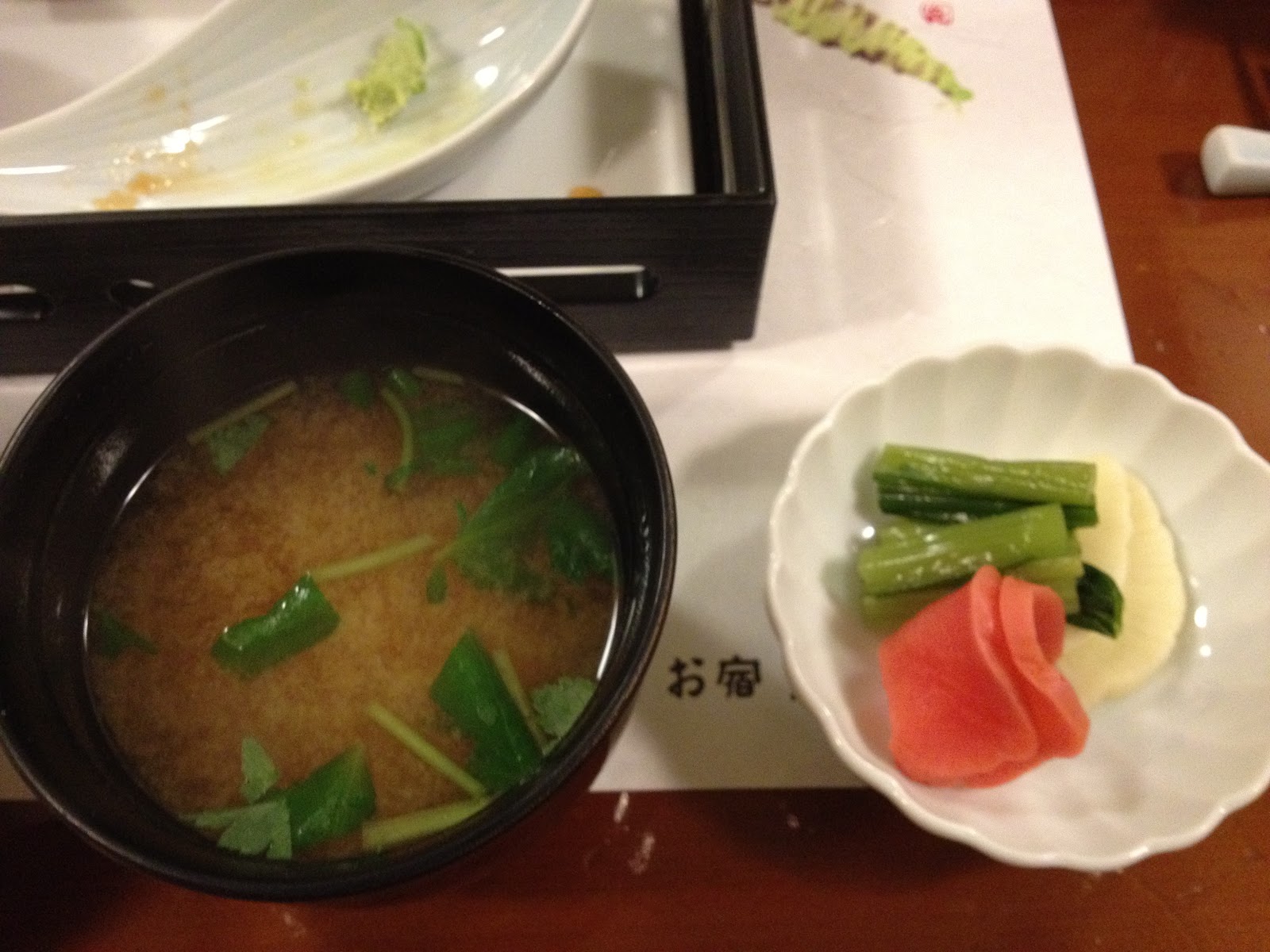
Food (TBU)


Monday, November 12, 2012

Book 1: Kissinger’s “On China”


I took several classics with me, mainly to learn something about Japan while I’m here:
戴季陶’s 日本论
新都户稻造’s 武士道
Ruth Benedict’s The Chrysanthemum and the Sword (菊与刀), and
Andrew Gordon’s A Modern History of Japan (standard text for university)

Ironically, it’s Kissinger’s “On China”, a book I didn’t initially intend to bring (because it is thick and not about Japan), that’s completely engrossed me in the past few days. Back in college, I had read 2/3 of Kissinger’s “Diplomacy” as required reading for Harvard’s Hist A12, the well-known “Conflict and Cooperation” class. I recall at the time being awe-struck by Kissinger’s fluid prose, intricate analysis, and succinct yet penetrating summaries. Particularly the early chapters on European balance of power politics until the outbreak of World War I, more than any other author I’ve read, Kissinger made the theory and practice of politics and diplomacy at once accessible and enlightening.

”On China” has all the hallmark of a Kissinger masterpiece, and again, the early chapters I believe are the highlights. Tracing the origins of Chinese political worldview from the myth of the Yellow Emperor, to the empire’s rise to preeminence and subsequent decline, to Mao’s declaration in 1949 that the Chinese people “have stood up”, the first 90 pages is a concise primer on modern Chinese history and a penetrating appraisal of the Chinese political psyche, written with a familiarity, available only to someone who has practiced at the highest levels of Sino-US relations for five decades.

Building on this foundation, the next 450 pages mainly analyse and account the evolution of Sino-US relations from Mao to Deng to Jiang on the Chinese side and Nixon to Bush (senior) presidencies on the US side. The best parts here were his account of the intricacies of US-China détente, Mao and Deng’s motivations for war in Korea and Vietnam, and Sino-Soviet split. It’s been typical to view 1949 as a break in China’s historical development. Kissinger, however, deftly show and repeatedly emphasize that continuities in self perception and world view among Chinese statesmen are crucial to understanding the Chinese concept of world order and their strategic decision making. These pages are well written also, but maybe these events are relatively recent, or others have written prolifically on similar topics, I came away still thinking the first 90 pages were the best.

Some quotes which I thought were illuminating:

Unlike conventional states, which “cherish a tale of their origin, a special feature of Chinese civilization is that it seems to have no beginning… The Yellow Emperor has gone down in history as a founding hero; yet in the founding myth, he is reestablishing, not creating, and empire. China predated him; it strides in to the historical consciousness as an established state requiring only restoration, not creation.”

On the nature of the Chinese state: “the borders between China and the surrounding peoples were not so much political and territorial demarcations as cultural differentiations… in the modern age, China remains a ‘civilization pretending to be a nation-state’.”

On Chinese relationship to religion: “China produced no religious themes in the Western sense at all. The Chinese never generated a myth of cosmic creation. Their universe was created by the Chinese themselves, whose values, even when declared of universal applicability, were conceived of as Chinese in origin.”

On China’s historical geopolitical situation, and remarkably relevant still today: “Individually, neighboring peoples could pose formidable threats; with any degree of unity, they would be overwhelming… The Great Wall, so prominent in Western iconography of China, was a reflection of this basic vulnerability, though rarely a successful solution to it. Instead, Chinese statesmen relied on a rich array of diplomatic and economic instruments to draw potentially hostile foreigners into relationships the Chinese could manage.”

And commenting on China’s depredation in the later Qing years: “Chinese statesmen played their weak hand with considerable skill … From the point of view of the balance of power, the objective configuration of forces would have suggested the impossibility of China’s survival as a unitary, continent-sized state. But … China eventually overcame its travails by its own efforts. Through a painful and often humiliating process, China’s statesmen in the end preserved the moral and territorial claims of their disintegrating world order.”

After reading the book, one can clearly see Kissinger’s respect for Mao (“philosopher-king”) is close to being on par with his veneration of Sun Tze’s “Art of War” (whom he credits also for providing Vietnam with tactical and strategic advantages in the Second Vietnam War). Next in the rung is Deng (“battle-hardened guardian of the national interest”. Then Zhou (“the mandarin” who “conducted conversations with … effortless grace and superior intelligence”). Kissinger had also high praises for Jiang, Zhu Rongji and Qian Qichen for following through with Deng’s vision and building up China’s modern economy.

The upheavals since 1840 severely challenged the Middle Kingdom’s traditional notion of political ‘singularity’, cultural superiority, economic independence, and aloof isolation. In the 19th and early 20th centuries, the primary forces were military and the devastating defeats coalesced a modern nationalism and prompted generations of deep and painful soul-searching.

While the China that emerged post 1949 is a more conventional nation state that has let go of much of the pretensions of the Middle Kingdom, it has not abdicated the notion of the its exceptionalism. To a large extent, the exceptionalism espoused by the Middle Kingdom, was made possible by its regional preeminence and sustained by distances insurmountable by then available technology. As those barriers broke down in the early 19th century, China descended into 100 years of chaos and deprivation.

The question could be asked in today’s vastly more interconnected world, to what extent is exceptionalism as a concept sustainable, not just for China, but also for other nations espousing similar ideals. China’s lesson is perhaps that exceptionalism made possible by preeminence, however long and secure it may seem, is nevertheless a shaky foundation for a modern nation state. As we observe our condition with humility and see through to those patterns of our shared humanity, the future for all of us is more alike than different.  


Sunday, November 11, 2012

Ride 6: 富士见高原 to Matsumoto (松本)

65km, cycling time 8:50AM until 3:30PM, overcast most of the day until around 1:30PM, then rain with increasing severity. Temperature ~5C in morning and ~8-10C during the day.


I had expected downhill until around Chino, but there was actually a slight downhill all the way to Suwa. After going around Lake Suwa and a climb after Okaya, the downhill lasted all the way to the outskirts of Matsumoto. I managed ~25-30km/hr for about 12km before Matsumoto - just as well since the rain was really picking up.


Leaving ryokan Ryozo at 富士见高原 with the very kind owner. One of her CD's was Leona Lewis, which reminded me of my college blockmate Joe Hong's amazing cover. Check it out: http://www.youtube.com/watch?v=hThGYp5ZRLw&feature=youtube_gdata_player

Houses in the 富士见高原 area - reminds one of New England right?


About 3km from departure point - hundreds of people spread out over several kms trimming weeds and cutting grass by the highway. This was a Sunday and for some reason my first reaction was the state organising public works for the unemployed since their gear is quite uniform and very mechanised (like most of Japan). But the more I observed the more these guys looked like volunteers. Most were in their 50s and 60s. Tough workout and very impressive.


Nice autumn colors along the way. From this point, I went for 20km of downhills until Chino...

Scenery during the downhill - mountain villages and fields. Biggest problem with downhills is the cold. No heat generated through exercise and windchill! Need a motorcycling jacket more than any cycling gear! I put on all my clothes and honestly if there were another 5km of downhills, I would have had to rest to warm up before going any further. Good thing is this is the fastest 20km I've done all trip.


I'm big fan of vegetable patches and here's a typical farmhouse with vegetable patch I've encountered throughout my trip so far. The Shinto shrine is to the side of the field. Also note the campaign poster - see these everywhere in rural Japan. Their votes must be important. I even saw a posters for the Japan Communist Party!

Arrived at Lake Suwa (11:22AM). Not a particularly large lake - 24th in Japan, but quite industrialized all around. I was surprised to see so many industries this far up a valley, but apparently the Suwa area is a well established precision instruments manufacturing base. Sayo Masuda (Autobiography of a Geisha) tried to drown herself in this lake as a child but didn't do it in the end.


Example of such a factory. Quite a few Epson plants also around. If this were China, only 乡镇企业 would exist this far up a valley. Not sure how well these guys are doing (or will do in the future, as competition in places like China become more sophisticated) but impressive nonetheless that they've gotten this far.


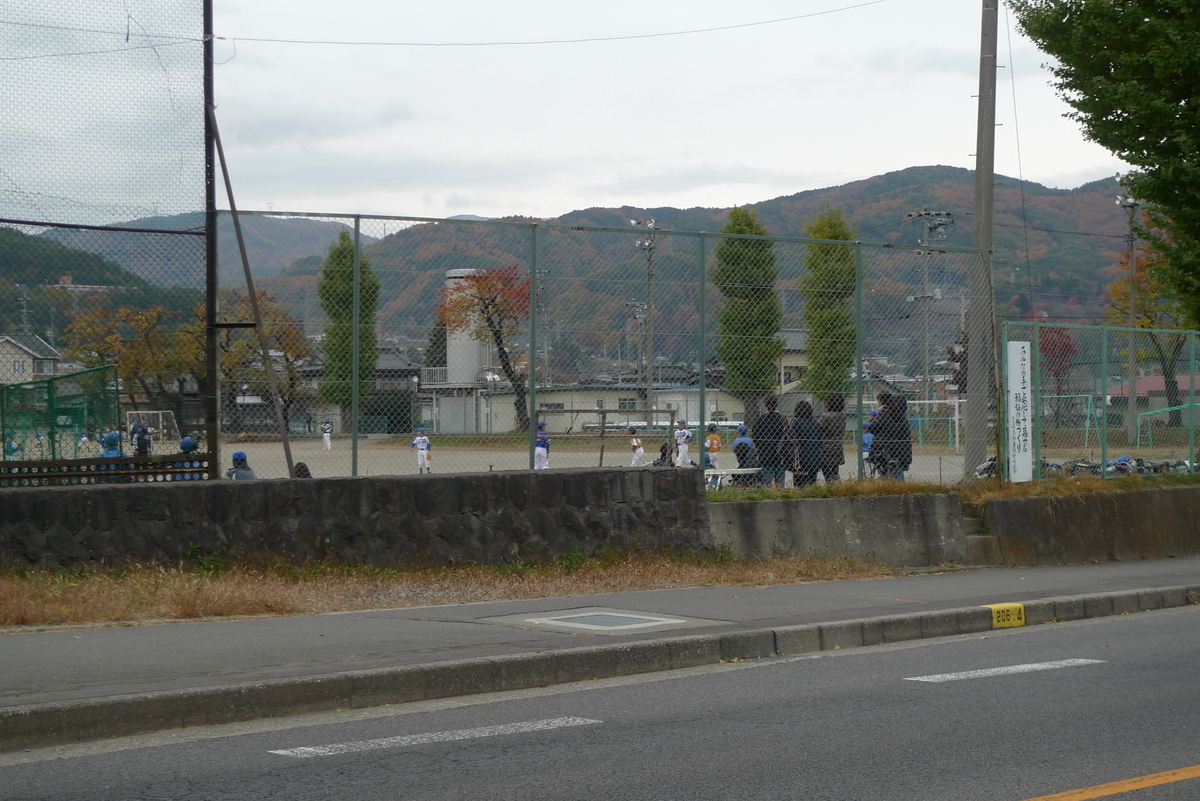
It's Sunday and kids play baseball. It's the mothers that take them there. I tried to find fathers but couldn't find one!


I learnt motorcycling basics in a plain old carpark in the Bronx. This is one fancy car park! It even has a simulated railway crossing and traffic lights. I guess this is what they do in Japan.


Beginning of the climb at Okaya; great view of the city and lake below.


View from the top of the hill before the downhill into the Matsumoto valley. Couple minutes into the downhill, light rain started to come down - improvised rain cover for the laptop using cover designed for the handlebar bag. Usually laptop lives in the waterproof rear sidebags but too much hassle to put it back. Have used laptop's power USB port in sleep mode as iPhone charging device. Great innovation. Can't wait to get the Lenovo Carbon!


Well, end of Route 20. It has taken me from Tokyo thus far. Rain is pretty strong now but at least I'm on a slight downhill for next 12km to Matsumoto.


Entry into Matsumoto is anything but inspiring. But many Japanese cities I've encountered seem to look like this on the outskirts.


Bowl of hot ramen in the city, and another 20min ride through the rain and I checked into Ryokan Seifuso across the river from the university. Rode the fastest 65km so far. Great feeling!